The Scout and the Enforcer
Returnal (2021) and Saros (2026) are, on paper, very similar games. Same studio, same third-person camera, same fast pace and twitch reflexes, same blend of science-fiction and cosmic horror and roguelite mechanics. They are so similar, in fact, that the Saros gameplay reveal made me feel like I had a controller in my hands.
They are also quite different, as reviews for Saros were keen to stress. Come back stronger, promises the back of the box. Reviewers got the memo: many of them focused on progression, pitting Returnal's near-total reset between runs against Saros' sprawling upgrade tree, Selene's frustrating lack of growth versus Arjun's satisfying accumulation of power.
My argument today will be that the permanent upgrades are the least interesting change between those two games. Expect full mechanical spoilers and mild plot spoilers for Returnal and Saros.
Ever forward
The first area of Saros, the Shattered Rise, will eventually bring you over a short bridge between two statues, and into a room with two tall ornate doors. One is to the left, the other straight across. On your first run, only the leftmost door will be open. It will close behind you: you will not notice, too distracted by Architect taking flight in the distance.
You will never see this particular piece of the map again. On every subsequent run, the door straight across is the one that will be open, and the one that will close behind you. This is when I noticed that this, indeed, was a very different game to Returnal.
See, one of the most deliciously evil mechanics in Returnal is that health items become max health upgrades if you don't need healing. Once I understood this, I started playing in a very specific way, and winning more: I would leave healing items behind me, small ones especially, clear a few rooms while accumulating damage, then take a full heal and backtrack to collect what was now a generous sprinkling of upgrades.
You can't backtrack in Saros. Not really. Not as far. Where Returnal built sprawling maps with a network of teleporters, Saros biomes are all one-way doors (Ancient Depths, Cathedral), death-defying drops (Shattered Descent, Yellow Shore) and magical ziplines (Desecrated Fortress, Acolyte's Haven) with no return path. The one exception is the Blighted Marsh, which will let you trudge back miserably for unclear gains if you really want to.
Returnal only locks you into forward progress in the final area of the main game - the Abyssal Scar, an explicit point of no return in the narrative that is clearly intended as the harshest challenge you have faced yet.
I was confused initially. So much of my fondness for Returnal laid precisely in this ability to go back, to leave things behind for future use, to turn each run into a complex mental web of "Okay so if I get this much money then grab this parasite before buying this artifact before tackling that fight..." strategizing. Saros took away all that complexity and replaced it with a constant push.
Selene reflects and ruminates. Arjun does not look back.
The illusion of choice
Key to Saros' aesthetics and worldbuilding is the eclipse. When you call it, via an ominous-looking "device" that is definitely not OSHA-compliant, the planet catches fire and the game gets harder. This mechanic is introduced in contradictory ways - the tutorial text suggests it's a challenge you can take on for extra rewards, the level design puts an impassable door in front of you that will only open once you obey the prompt.
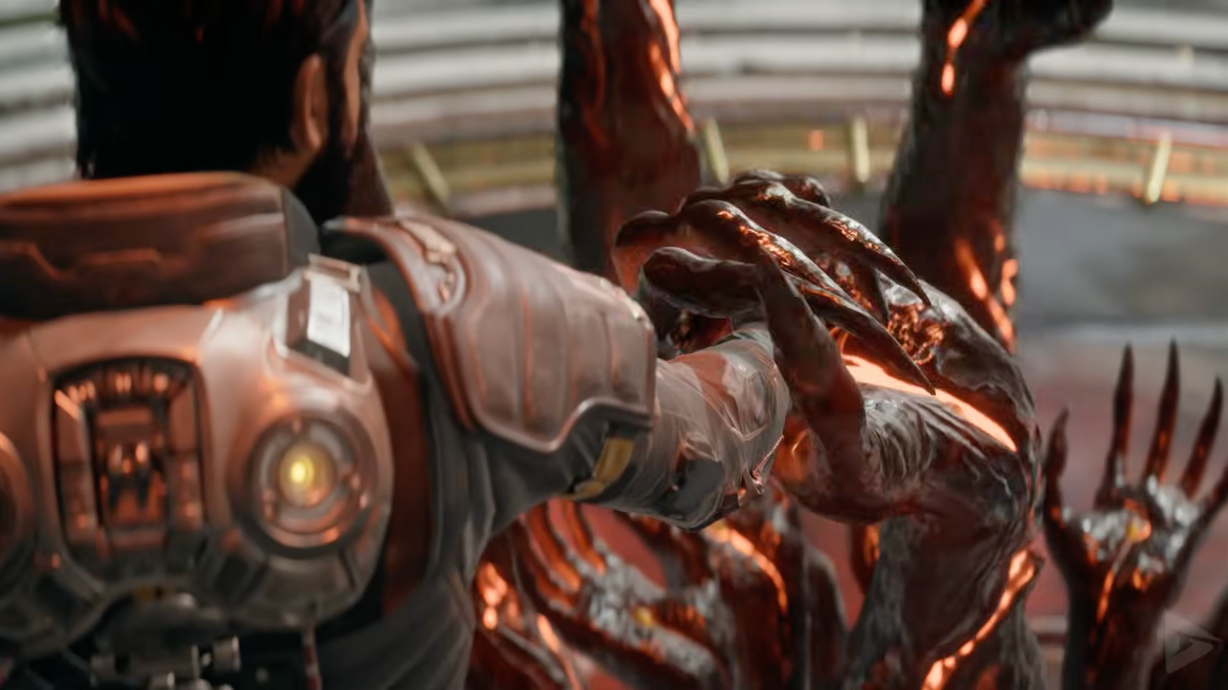
This, again, repeats throughout biomes. Shattered Rise has one mandatory device. The Ancient Depths give you a choice for exactly half the level and no more. Shattered Descent forces you to call the eclipse from the very start, as does Cathedral. The Desecrated Fortress and Acolyte's Heaven allow you to opt in or out until a giant pit bridgeable only by the aforementioned magical zipline forces your hand. The Blighted Marsh, once more, stands out: there you can wait almost until the boss door.
With "eclipse mode" being mandatory this often, the consequence is that it cannot be as brutal as it promises to be. It is no masochistic challenge, no "high risk high reward" gamble, simply one more obstacle you can - and will - traverse. It is balanced accordingly. Fairly quickly, you'll simply activate the thing as early as you can, unless you cannot be arsed to deal with the mild inconvenience of a slightly more hostile environment on your way to your actual goal.
Arjun is confident. Why would he not be?
Getting away with it
Returnal's key mechanic keeping your power in check is Malignancy. Items can, at random and with varying frequency, be "malignant", i.e. cursed. Pick them up, and you have a chance to acquire a Malfunction. Malfunctions are debuffs heavily impacting your ability to fight enemies or traverse the maps. They are punishing and dangerous: they will alter the way you play until you clear them - and you can clear them, typically by completing a small side objective such as collecting some resources or killing a few enemies a certain way.
Rather than a true obstacle, Maligancy becomes a gamble, a tradeoff. Should I risk grabbing this upgrade? What resources do I have on hand if I need to clear a Malfunction? Are there enough enemies or pickups left? Or can I live with a longer dash cooldown, a scrambled map, enemies that fight back in new ways?
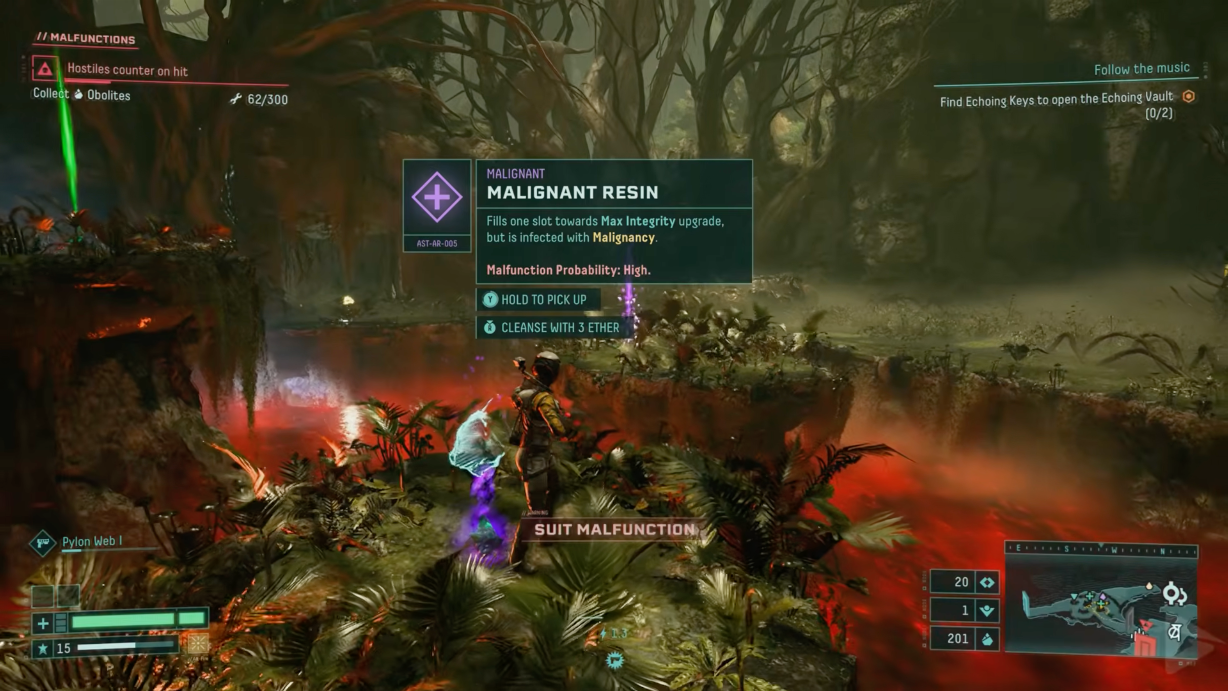
The same debuffs are also found on Parasites, paired with appealing stats increases or game-changing modifiers. Do I want this? Is it worth it? Can I get rid of it if the conditions change? What compromise can I afford to make? Will I get away with it?
Saros will not make you think nearly as hard. On paper, it offers you risk-reward calculus, primarily through Corrupted Artifacts and Volatile Attributes. Neither matter. Let's get into details.
Artifacts are nondescript cubes that alter your stats. They typically come with a larger bonus and a smaller malus. They sometimes also have a small perk. Once the eclipse is active, they become "corrupted" and also come with a small debuff. I have routinely stacked 5 instances of the same debuff and noticed no difference to my combat skills. The increased dash cooldown does get me sometimes. Otherwise, none of it matters.
Volatility is a late-game mechanic where increasing one of your stats too much can apply a malus for the rest of the run. None of those matter either.
Resilience, which controls your amount of Integrity (that's health), becomes Arrogance. It hides enemy healthbars. This does not matter because an enemy is either alive - in which case, keep shooting - or dead - in which case, start shooting something else.
Command, which controls your amount of Power (think of it as a magic gauge), becomes Ignorance. It hides corruption effects on Artifacts. As has been established above, this does not matter because the corruption effects aren't actually a hindrance.
Drive, which controls the rate at which you accumulate Lucenite (more or less experience points), becomes Negligence. This means you will not bring any Lucenite home to purchase upgrades from the tree if you die. By the time you can encounter attribute volatility at all, you are likely well over 80% through the tree and this is not much of a problem.
Selene always has to think about trade-offs before she does anything. Arjun passes threshold after threshold and he is never punished for it.
Brain or muscle
While Saros and Returnal appear to play very similarly on the surface, the second-to-second gameplay is in fact extremely different. This is because under the guise of near-identical gunplay, Saros gives you a much more complex combat moveset.
Both games are third-person shooters that give you a main attack, a jump, a grappling hook, a highly responsive dash that can traverse obstacles and hazards, a strong but risky melee move, and a powerful secondary attack that needs charging. Saros adds a shield, an alternative firing mode for every gun, a special jump, a parry, a finisher, an extra-strong move that charges as you inflict damage, and switches the secondary attack charging from time-based to action-based.
A threat in Returnal calls for one of three responses: move out of the way with or without dashing, jump above the hazard, dash through the projectiles. Bullets and lasers are either the kind that you can dash through, or the kind you can't. That's it. All other complexity comes from what you have collected and how your specific selection of artifacts, weapons, parasites, malfunctions and single-use items can best sing together to get through whatever you are facing.
A threat in Saros calls for choosing between the same three responses as above, plus an extra two: put up your shield to block and absorb projectiles, or parry to return them to sender. Bullets are either the kind you want to absorb with your shield, the kind that reduce max health and you want to avoid, or the kind you can't dash through but can parry. That is a lot more options to think through on the fly! Absorbing projectiles with the shield is the main way to charge the secondary attack, adding one more parameter to keep in mind while shooting.
The result is that Saros feels like much more of an action game - and Returnal was hardly a sedate affair to begin with. But it put a lot more emphasis on finding and choosing your kit than on how you act during a fight, despite also having exquisite gunplay and superbly responsive controls. Most of the build-crafting complexity is gone in Saros, in favor of a considerable increase in depth during combat proper.
I don't think it's a coincidence that Saros also features a lot fewer of the advanced platforming and puzzle challenges that were all over Returnal. The few that remain only start having some bite once you reach the Yellow Shore, and even then they are more focused on twitch reflexes than problem-solving.
The different minimap design also illustrates this difference. In Returnal, entering a room populates the map with icons for everything you can find there. It encourages you to look around, spot the platform the thing is on, and start asking how you can even get there. The answers will vary: vines that pull you up, clever jumping, traversal tools you unlock until the very last act of the game.
In Saros, icons only make it onto the map when you are very close to items, and there are considerably fewer things to pick up anyway. The answer to "How do I get there?" will at first be that you don't have the ziplines yet, then it will be that you should have called the eclipse earlier to enable the zipline. The reward will always be a generic artifact you did not actually need.
Selene has a sword. Arjun has his fists.
Two house(marque)s, both alike in dignity
This might look like I'm saying Saros is a worse game. It's not. It is, however, less cerebral, and simultaneously more brutal and less punishing.
Returnal is a game about trauma and motherhood, about being stuck in a loop of guilt and regret, about going back again and again and again. It is a game about being punished eternally and finding pleasure in madness.
Saros is a game about greed and abuse, about pursuing your own desires with no regard for others, about barging forward again and again and again. It is a game about never being punished and the way that warps you.
Selene is a Scout. Arjun is an Enforcer. And if there's one thing the databank in Saros really wants you to know, it's that every gun used by Enforcers was once designed for riot control.