Saros: not quite what you want, not quite what you need
The sun went dark today. It seemed only fitting to jot down some notes about Housemarque's latest effort. Longer essays will come later, whenever I feel like it: these are simply loose thoughts, kept as spoiler-free as possible.
saros (noun)
The period of time, just under 19 years, between successive lunar or solar eclipses occurring when the sun, earth, and moon are in the same positions relative to one another. Also called saros cycle.
The American Heritage(R) dictionary of the English Language, 5th ed
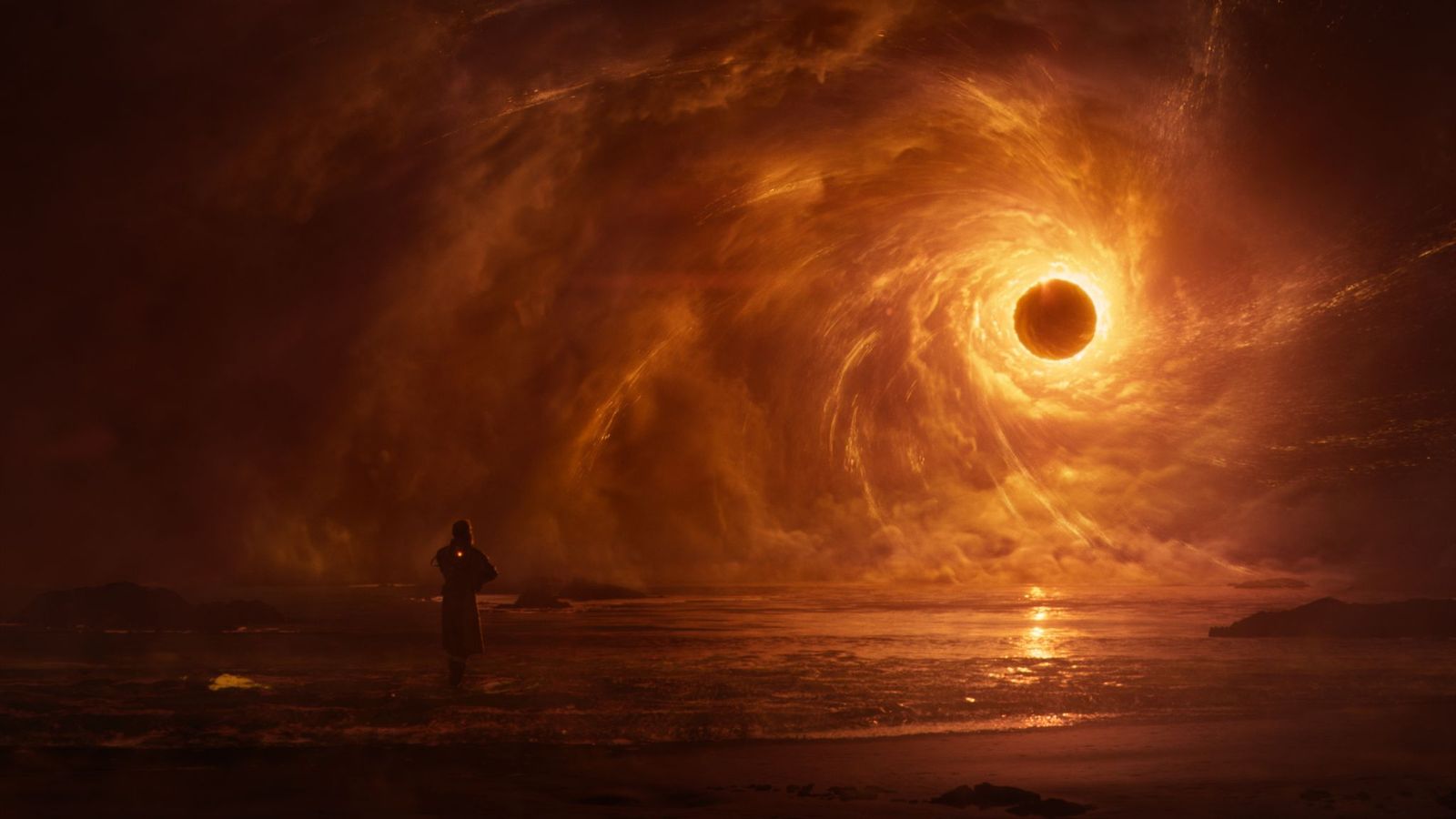
It's impossible not to compare Saros to Returnal. They're so alike at a glance. Roguelite mechanics, walls of bullets, fast and snappy third-person gunplay. Psychological cosmic horror and polished sci-fi aesthetics. Same studio. Greater ambitions.
Before I get to anything else I must stress that this game is beautiful. Aesthetics and visuals are not my focus here. I do wish, nonetheless, to congratulate the art team on their truly stellar work. Someone who knows architecture should get really weird about this game. There'd be so much to say.
Returnal was a profoundly dark, lonely, introspective affair. I have poured well over 200 hours into the thing and gone on at length about its cleverness. Pitted against its successor, the brilliance brought on by what was surely ruthless scope management only becomes more obvious. This isn't to say Saros is bad - it'd be so much easier to wrap my head around it if it was.
Saros wants to be more. "Come back stronger", whispers the back of the box, the bullet points swearing that this time you will be granted steady progression. The in medias res opening promises a grand tale of lost love, a pleasingly varied ensemble cast, sharp corporate satire. It somehow feels fitting that a game so deeply concerned with desire, with greed, with ambition and what it does to us, would itself fall short of what it attempts.
The resilient search and rescue team that never was
The characters were clearly crafted with care and integrity. There is no cheap cliché here, they are all attempts at well-rounded interesting people steering far from racist and sexist archetypes.
Unlike the average horror movie, however, we do not get to meet them while circumstances are still normal, and that is where it all goes wrong. The story starts after things have already gone to shit: it skips an Act 1 that would install normalcy and make us care for those humans who will inevitably face a dark fate.
In avoiding tropes, Housemarque unfortunately also made their characters harder to relate to. Tropes are shortcuts that make us (think we) get the full picture of someone very quickly. Without either that often-bigoted scaffolding or enough time to learn to know them, the player is left with a sense of hollowness that feels unintended.
The voice performances are solid enough, animation that smells of budget restrictions never was too much of an obstacle. Subpar dialogue writing unfortunately makes it all fail to truly gel. Nobody ever laughs. Nobody ever argues. The closest we get is the commander's display of arrogance, swiftly cut short by the plot. Ensemble casts live and die on camaraderie, teasing and conflict. This ensemble cast dies in more ways than one.
I do wish to spare a shoutout to Stack: it is entirely too rare to see a character who uses they/them pronouns in a big game to begin with, rare to have that character be a person of color, rarer still to have them be an older, masc-presenting adult whose gender is respected by all and an absolute non-topic. Thank you for that, Housemarque.
I wonder how the locs handled it. I should check. Also, you folks localized this to Arabic? I need to check that too.
Too-perfect command over streamlined challenge
Gunplay feels good in Saros. Gunplay feel great in Saros. It is both an easier and a harder game than Returnal - steady progression and generous challenge modifiers, but also more complex mechanics and more linear paths through areas leaving fewer opportunities to build power.
Complexity in Returnal was primarily found in exploration and build-crafting. Malfunctions were core to the difficulty curve: get an extra item, be maybe-punished by a brutal debuff and a miniature sidequest to get rid of it. These were for the most part genuine hindrances, but also removable by playing differently for a little while. It was all a game of constant trade-offs, from the start of a run to its very end. The core actions were by comparison fairly simple: shoot, dodge, reload, alt-fire, use items, all nuanced by whatever you had picked up on the way.
Saros instead puts that complexity in the moveset, starting with the shield featured in the gameplay reveals. Without going into late-game details, you have more options for how to respond to aggression in every given moment. Everything hits hard and has more health than you'd like. The trade-offs are gone: punishment mostly comes as a threshold you pass and can't return from. This makes it have less bite than it should.
The titular eclipse is a prime example of this. It gets introduced as something of an alternate mode: make the game harder, make the world stranger, reap greater rewards. Except the only choice you get is when to call the eclipse down, not whether to call it. The result is a game balanced for its "harder" mode. No trade-off. Nothing to lose.
It's an amusing reflection of the game's narratives and gender politics, in a way. Returnal's Selene, a Scout, spent her life fighting to hit an impossible balance. Saros' Arjun, an Enforcer, is nothing if a man of callous ignorance and excesses going unpunished.
The most interesting weapon that our Enforcer gets to wield is oddly reminiscent of a Taser. I wonder who else goes through life with their excesses going unpunished.
A noble drive towards social critique
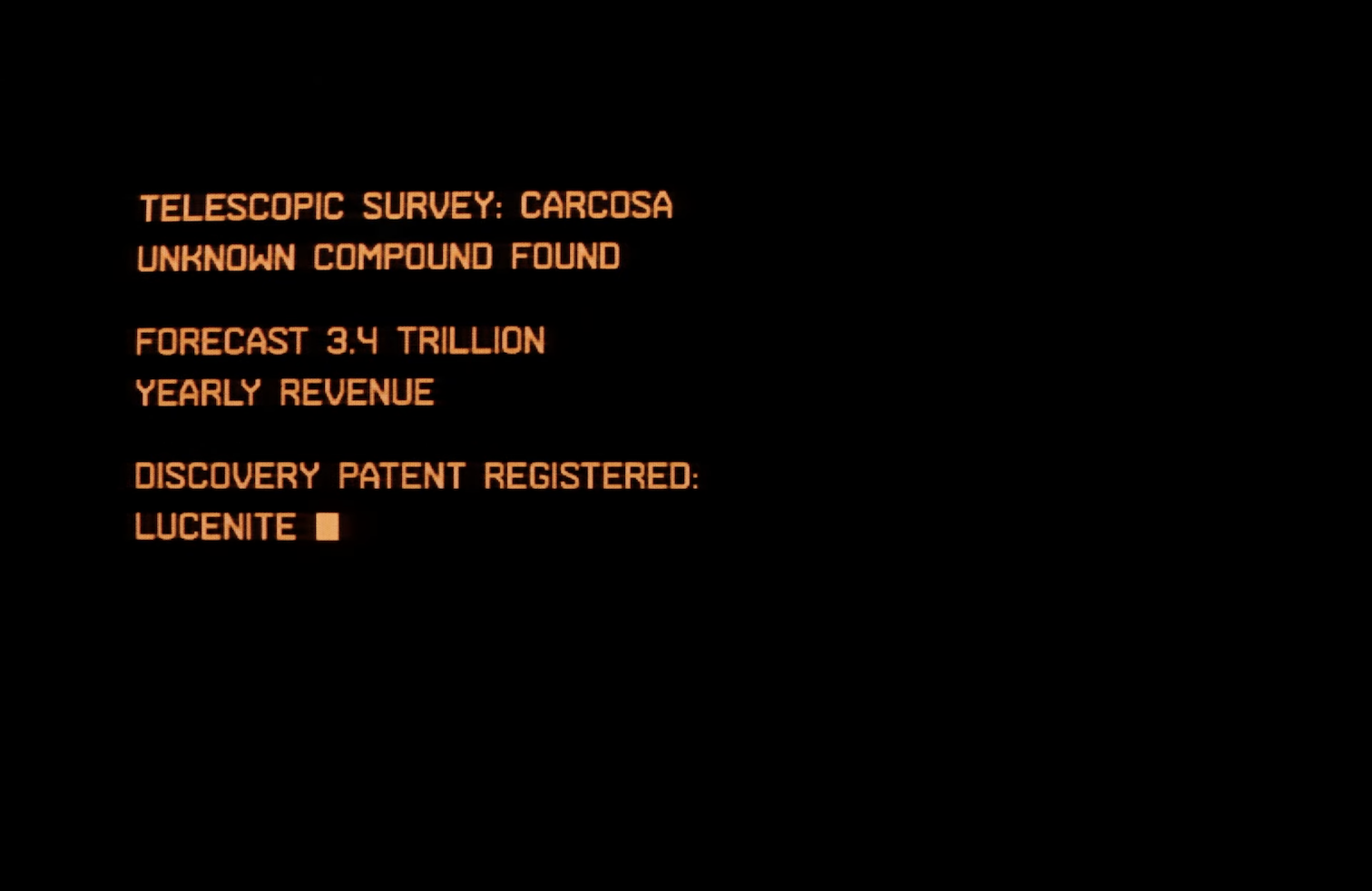
The very first screen of the game makes it clear that Housemarque returned to the Alien well. Returnal took the Xenomorph, Saros took Weyland-Yutani: its version is called Soltari. Soltari's quarry, named Lucenite, serves as experience points and currency. It is no accident that those two concepts are one and the same.
Much like its predecessor, Saros refuses to deal in finesse and nuance. It is vague and purposefully obscure, yes, but none of the big reveals are subtle. They will get hammered into you, again and again and again. Soltari is an evil greedy corporation. This is not a spoiler. The accumulation is what makes it compelling.
There's another story there, too. That of a man who went to space to find his wife. Of the razor-thin edge between a man who kinda sucks and a brutal abuser. Saying more would be spoilers.
The way those tales - the corporate, the personal - get intertwined is interesting. I don't think it's executed especially well, maybe out of negligence, maybe due to production constraints, maybe due to those noises I've heard suggesting Housemarque employees should very much unionize. Nonetheless, I respect the attempt. I respect the directness, I respect the stance being taken, especially by a big-ish-budget shooter made in a country being choked by the far-right just like so much of Europe.
I'll take an interesting failure over cowardice any day
Saros is about greed going unpunished and how it warps you. It doesn't quite succeed in what it attempts narratively. It mostly succeeds in what it attempts mechanically. Yet somehow, the way its gameplay echoes its themes is uniquely sharp. Returnal was a masterclass in that department: Saros surpasses it.
This feels absurd to write. It's a worse artwork, story-craft-wise. It will not, in itself, haunt me to nearly the same degree. And yet, the way every little detail of what makes it tick serves the topics it wants to discuss, the delicious irony of the project's own hybris echoing what it's about...
And look. The guns feel really fucking good.