Backrooms fails to twist power as it does space
It's Saturday afternoon in the last stretch of a historical heat wave. My apartment's about to hit 29C again. I check what's on at the nearby theater, desperately hoping they have decent AC (they do not). Backrooms is the least unappealing of the bunch, they even have it in English for a change.
I'm not familiar with the source material - anything spawned from 4chan tends to push me away, and it never sat well with me to see a word I know from gay lingo turned into horror memes. Nonetheless, I've heard good things. Off I go.
This piece contains major spoilers for the plot of Backrooms, but I'd argue that's the least interesting part of the thing anyway. We'll also, unfortunately, need to discuss violently racist imagery and clueless portrayal of psychiatric power, via gendered (but not sexual) violence. Which means I also must mention that I'm white - if you've seen writing from Black critics about this movie, I want to read it, please send it my way: contact info's in the sidebar.
Mundanity dialed to eleven
First, the good. Backrooms does a stellar job of bringing its so-called "liminal" spaces to life - as physical sets, even. It takes familiar corridors and rooms but weirds them by assembling components with the logic of a level designer rather than that of an architect. Light and shadow, view angles, narrow tunnels that frame the view just so for a spooky reveal: the early stages of exploration are closer to a N64-era FPS deathmatch map than anything intended for human use. That on its own would be strange but far from terrifying.
It is the props, then, that make it all deeply unsettling. A level would either remain abstract or have careful, evocative set dressing; Backrooms instead fills its endless carpeted halls with agglomerated detritus inspired by its visitors. It initially grants those sculptural assemblages the kind of breathing space that a white cube gallery would lavish onto big-name artists. The props beg for attention, for attempts at interpretation, at sense-making. There is none to be found.
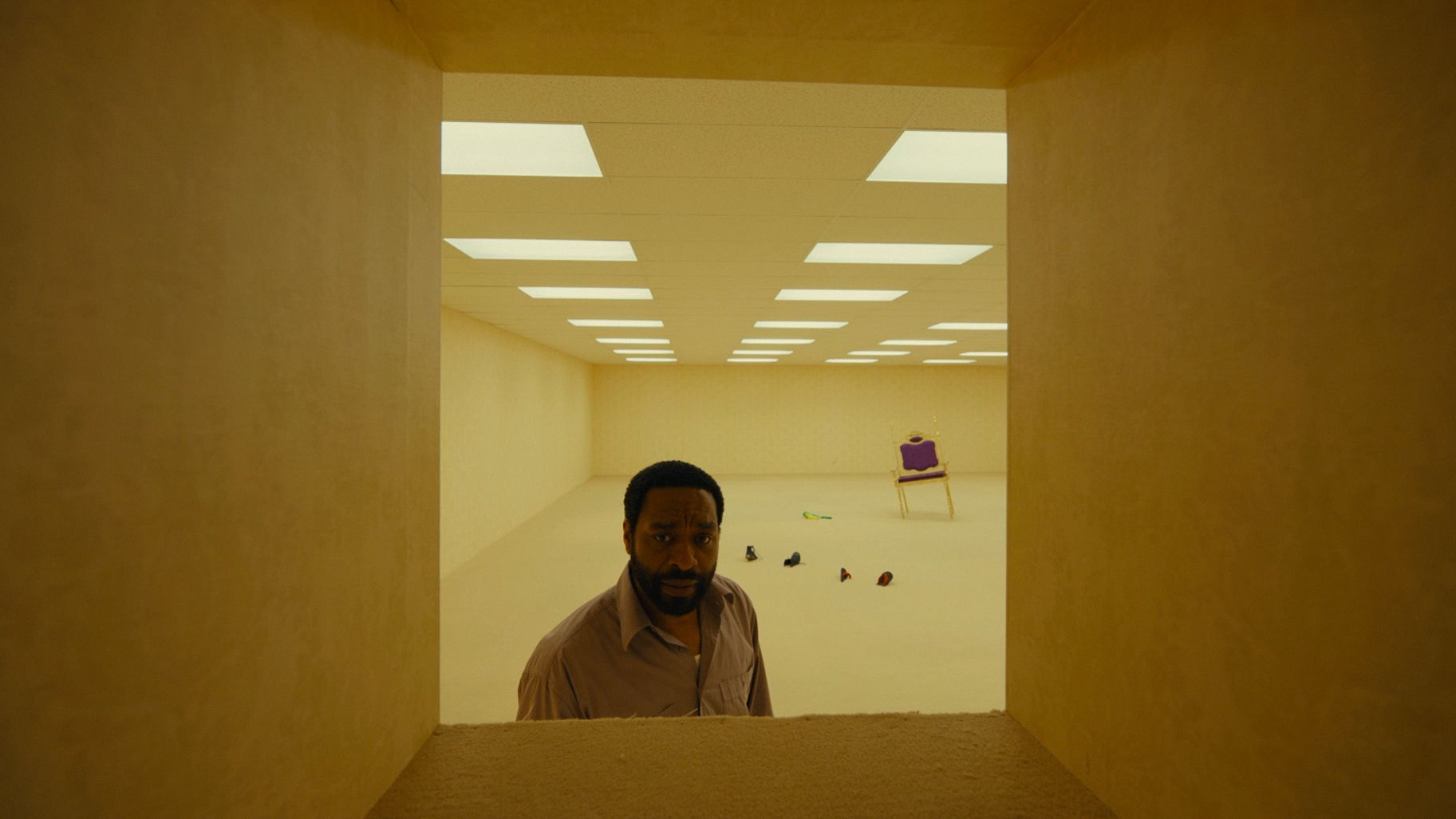
Soon enough, in what can be described as the movie's turn to more classic horror, the rooms will fill with literal garbage. I'd argue this is weaker - almost cheap. The movie is at its best before that turn: masterful use of sound, halfway between noise and music, ratchets up tension as our protagonist looks around this strange place, inexplicably compelled to keep exploring. He is, after all, a failed architect.
Thing is? He is also a Black man.
These characters fucking suck (appreciative)
Backrooms has two main characters. Clark, a Black man, is an alcoholic furniture store owner who was made homeless when his (white) ex-wife kicked him out of the house he allegedly paid for. Mary, a white woman, is his therapist and a self-help coach selling audio tapes and books via cringy television ads. It's fairly plain that both of them are pretty terrible people.
Clark is not initially shown to be abusive. His retelling of the break-up makes it clear he was at the very least a terrible husband with the potential to be violent. He wanted to be an architect but it did not pan out, he instead ended up failing to sell shitty furniture from a big everything-on-sale-no-credit store with a godawful pirate gimmick. Chiwetel Ejiofor plays this asshole beautifully, making him both compelling in his struggle and thoroughly impossible to truly sympathize with. This is good, I love myself a horror protagonist who's fucked up.
Mary is best described as aloof. We get insight into her childhood trauma, we witness her failure to socialize without medication, we see her watching her own TV ad on a crackling CRT. She's quite clearly out of step with the world and there is something almost ethereal in the way Renate Reinsve portrays her. This is good, I love myself a horror protagonist who's going to get forcibly dragged back to Earth to maybe avoid dying horribly. Put both of those together, though, and...
Clark is the first to find the door to the non-space inside his store. He's the first to go exploring. He is not the first to die: he gets his junior employees killed by being reckless. He's the one who goes missing, indirectly pulling Mary in as she comes looking for him. He's the one who becomes the monster, strangling and kidnapping and threatening Mary to extract absolution from her.
The Black man becomes the beast. The white woman gets away, innocence incarnate. She even gets to yell at him that he's an asshole and can never change! Hell yeah clap back at the bad man you go girl.
But wait. Wait. Didn't we say she's his therapist? There was literally a scene where he asks whether she's ever forcibly committed someone, before confessing his impossible findings. She's white. He's Black. I can't unsee this. I can't ignore this.
Oh dear. Oh no.
When Mary wakes up after being betrayed and strangled, she is tied to a chair in a mockery of a family dinner. Clark, clearly unhinged, wants to re-tread a therapy exercise where she pretended to be his wife to get him to admit his mistakes. This time, however, he wants her to give him absolution. To re-enact the breakup once more, to make it clear he's done nothing wrong.
Around the table are a couple quasi-human entities, echoes of half-remembered humans spawned by this weird place. One of them is a red-headed white woman. Clark scalps her to create a wig, which he forces on Mary to make her resemble his ex-wife more. One of them is a white man, who Clark carves up to show that its foam-like insides are edible.
Was there not one single person on the writing team who saw this and thought "Er, guys, maybe having the one Black character engage in gleeful cannibalism and scalping is, like, bad optics or something"?
And it could be fine. It could be fine, if this was done deliberately, if it got commented on somehow. Instead, it is followed by the arrival of a gigantic, carnivalesque avatar of Clark as his pirate persona. Clark tries to soothe the creature - "We don't need to change!" and literally gets eaten alive. Would you like more Black cannibalism with your Black cannibalism?
The blood spills all over Mary. She runs, lest she gets eaten too. From now on the movie is a chase through more impossible spaces, the whole thing feeling like a thinly-veiled metaphor for the difficulty of escaping the very trauma we know she has endured. Maybe escape is impossible, even, as she eventually gets "rescued" by the scientists who have been trying to analyze the place for years and years. We do not see her leave the facility.
Mary, up to her name, is portrayed as innocent. She's a victim of her abusive, Mad mother, she's a victim of the violent Black man she was trying to help, she's likely a victim of manipulative scientists who will not let go. The film closes on her echo in a yellow room, sitting in peaceful silence. Clark's own echo, a giant flesh-eating puppet, is now lying on a stainless steel table, ready for researchers to carve open. Clark's body, meanwhile, likely lies unmourned deep in the labyrinth.
Get Fanon and Foucault in here
Let's speak plainly: this is racist. It is deeply, blatantly, bafflingly racist. I believe it was by accident rather than design - it is allegedly the result of so-called colorblind casting with a prewritten script. But this is why you hire sensitivity readers. This is why you adjust the script, especially when you have such competent actors on hand. At least cut out the cannibalism or do something more interesting with it. Please.
The movie is already aware of misogyny, of the ways in which abusive men show their hand long before the first punch gets thrown. The movie is aware of what Mary could do, as shown by Clark asking whether she has ever sent someone to be locked up in an asylum. The skills are there. Those actors could nail whatever you throw at them.
If the script had been adjusted to account for power dynamics, if Mary too was allowed to be a monster, if both protagonists found glee in their awfulness, the resulting movie would be stronger. Maybe even one fully deserving of becoming a true classic, as opposed to a kinda-fun romp with gorgeous imagery and a bunch of racism spoiling it. It would hardly be the first time that a movie changes around its people: famously, casting Duane Jones made Night of the Living Dead a very different film.
All it would take is accounting for psychiatric power and the legacy of white women getting Black men lynched.
Additional notes
There are other actors of color in the film. Avan Jogia plays the unseen researcher whose first-person demise opens the film. Lukita Maxwell plays one of Clark's ill-fated employees. Neither of those does much to challenge the disturbing racial dynamics going on.
I was made aware that Night of the Living Dead was a relevant citation by episode 10 of the Game Studies Study Buddies podcast, which features a sidebar on the necropolitics of zombie fiction. The podcasters heartily recommend the documentary Horror Noire: A History of Black Horror.
I think drawing a parallel with the videogame Saros, which is part of a different long tradition of weird horror and also centers a Man Of Color Who Fucking Sucks, would be interesting.
While I didn't look especially hard, the racial politics of the film seem under-discussed. I did find this article by one Eszter, which is on Substack (sigh) and mentioning Twitter discussions (re-sigh).
My angle in this piece does not fit an analysis building on everything Jacob Geller mentions in Control, Anatomy, and the Legacy of the Haunted House, but it's certainly relevant to what's going on here. It'd be nice if the movie was less racist so I could focus on its obsession with drop ceilings instead.