Rocket science and marshmallows against toxic nihilism
I want to stress that I am about to spoil key parts of the endings of Outer Wilds and its expansion Echoes of the Eye. If you plan to play that at any point, you should stop reading here. You only get one first time with Outer Wilds and it should not be this article. At least go listen to Errant Signal about why you should go in unspoiled before you take a decision.
If you can't play it yourself because the controls are not super-accessible to non-gamers, I recommend Playframe's excellent video series. Dan is a treasure, relentlessly chill and positive and funny, and a great choice for experiencing the game second-hand.
Thanks once more to Rob Haines for feedback on this piece and convincing me to reshuffle the sections into a more suitable order.
Last stop. Get out now. Good? Good. I will be building on Errant Signal's spoiler-packed analysis of the main game's themes and not bothering with a full recap, so go give that a listen first probably. Also, content warning for existential ponderings at the end of all things, that's kind of a must with any true discussion of Outer Wilds.
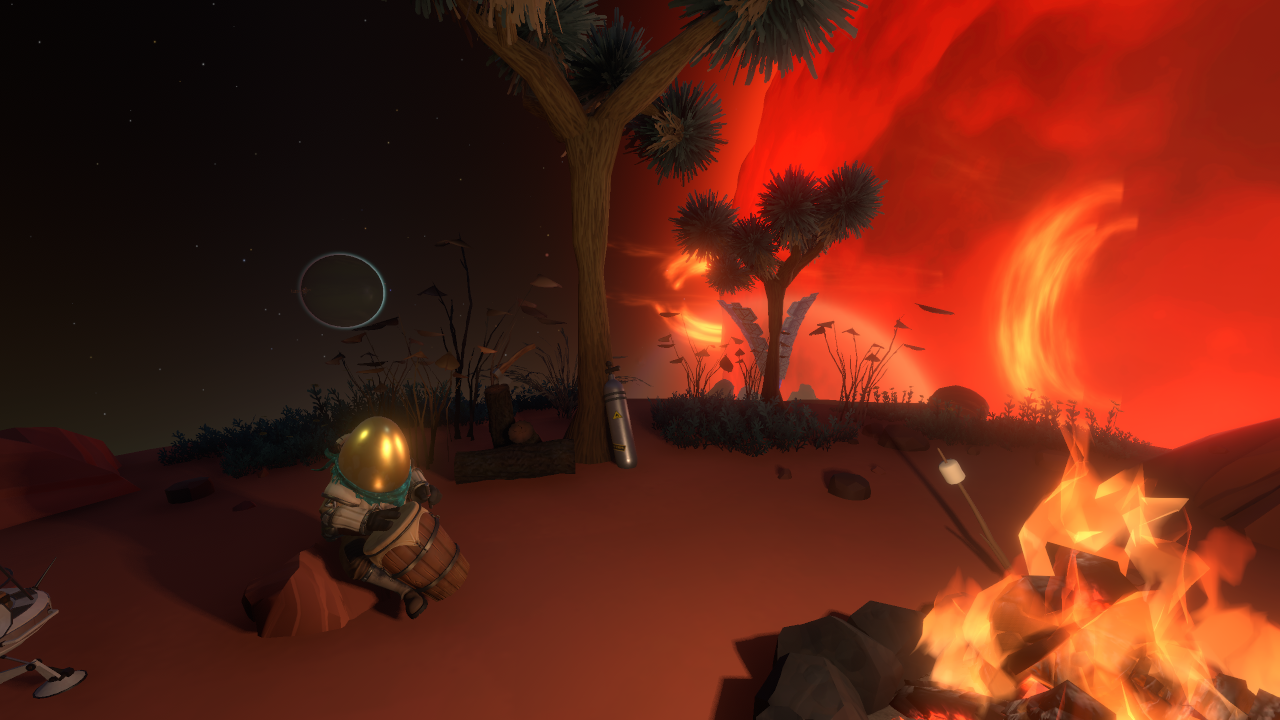
It's the stars, you see. All the other stars are dying out. Oh, why did we have to be born at the end of the universe?
Oh, who cares?! What does it matter?! Nothing matters anymore! The sun is about to go supernova! And me, all my research, my life's work, wasted!
Wasted, you understand?!
Outer Wilds is a 2019 first-person narrative exploration puzzle game, built on a 22-minutes time loop. Should you fail to meet your demise in a different - likely sillier - way before the time is up, the sun will go supernova and kill everything in your little clockwork solar system.
You start in your home village on Timber Hearth, cheered on by people you have known your whole life: it's the day of your first voyage into space! You seek out other Hearthian explorers on various planets, to hear their tales and share your findings. In 22 minutes, no matter what, everyone will be dead.
Chert, pictured and quoted above, is the astronomer of the lot. They've been updating the star charts and noticing entirely too many supernovae up there in the distant sky. Faced with unshakeable evidence of the end being near, they're not taking it too well. It's not just your sun. The entire universe is dying.
Outer Wilds is a story about The End, capital T capital E. It's a story about the end of everything, about odds you cannot beat... and about why you keep going anyway.
Considering the news lately, it's certainly tempting to give up. I like to joke that five or six or however many apocalypses is a bit too many to deal with, could we have just the one or two thanks? War, fascism, genocide, climate collapse, endless pandemic, whatever the fuck is going on with generative AIs, that's all too much. Maybe, then, it is easiest to work from the assumption that it is The End and that any effort is pointless.
Fuck that.
I have linked to Stop Telling Me What I Want before. This time, let me quote Dr Emily Price directly:
On a recent episode of the podcast Death Panel, the hosts discussed an NPR article from last year that blamed the author's immunocompromised husband for making his family continue to wear masks. In that episode, Bea calls the response to learning the state doesn't care about our health and deciding there's nothing to be done about it "toxic nihilism." This response is identical to the reply I get from people who have started habitually using AI. Here are some common talking points: AI has become so ubiquitous, we'll all have to start using it. The environmental impacts are overblown. And people suffer every day; how is AI contributing to that more than anything else?
It's that last one that really scares me, and gives the whole thing away.
I've made the parallel between covid and genAI myself before. My angle was different then because I focused on dissonance. What Dr Emily Price nails here is something different, something considerably more dangerous. Something that drives us to inaction and into a depressed form of complacency.
Toxic nihilism has us convinced that if we're not doing the max, we might as well do nothing. And more than that, it's right that we do nothing; we’re realists for doing nothing.
Again: fuck that.
The Unwinnable article above ended up in my Blueksy feed via it being quoted by Dr Emily Price quoting a quote of a wonderful panel segment by Doctor Tressie McMillan Cottom. The full hour-long discussion - which is well worth watching - is part of a conference series on "Daring ideas for the future" and happened in Detroit on 2025-11-19: you can find the whole thing on Urban Consulate's Youtube channel. The excerpt starts at 1:00:22. Here is my transcript of said excerpt:
When people try to sell you on the idea that the future is already settled, it's because it is deeply unsettled.
And I think about this a lot right now because I think that, you know, this promise of like artificial intelligent future - as we talk about the future - is really just a collective anxiety that very wealthy powerful people have about how well they're gonna be able to control us in the future. If they can get us to accept that the future's already settled, AI is already here, the end is already here, then we will create that for them. My most daring idea is to refuse.
[Co-panelists: "Jeez! Amazing!"]
I mean. The proposal for a post-human future is one where there will be human beings who will just be treated inhumanely. We're not gonna stop making people or humans. They're just saying we're not going to treat you as humans, and I refuse. And I think that we all can, I think that being Black is an act of refusal, I think we know how to refuse, I think everybody else needs to learn it from us. I think refusing is actually the more hopeful, expansive vision of the future than the one that is telling us that the future is already settled and decided. That's my daring idea. Just say no.
[Co-panelists: "Just say no. Just say no." Audience cheers and claps]
Please watch the excerpt's video if you can, the delivery makes it better still.
I won't re-stress the call to refusal: the case gets made succintly and beautifully already. Instead I wish to highlight the first sentence: "When people try to sell you on the idea that the future is already settled, it's because it is deeply unsettled."
That is a core part of the thesis of Outer Wilds. And, as someone who stubbornly refuses to catch covid if I can avoid it, it is a core part of why I'm still out there doing work.
In his analysis of the base game, Chris Franklin of Errant Signal makes the case that Outer Wilds is about learning. Specifically, "Outer Wilds is about learning as an endeavor in its own right, about how exploring the world around us gives us context, gives us understanding and fundamentally empowers us" (4:33).
He develops the argument further, notably stressing that the focus on space exploration, visuals rooted in hiking hijinks, and the use of quantum mechanics - objects that move when not observed - all converge towards a core statement: the importance of Being There. "Outer Wilds makes a passionate plea for space exploration by making it clear there's value in actually having people go out to these places and see these things. That theorizing and guesswork are great but don't replace first-hand observation." (18:28)
None of this is far-fetched. As Chris stresses, everything in the game works towards this point. And in case that was not clear enough, Solanum tells you, explicitely, when you meet her on the Quantum Moon:
Conscious observation forces a quantum object to collapse to a single possibility. But what would happen if a conscious observer somehow entered the Eye itself?
Over time, this has become my clan’s greatest question.
When you reach the ending and assemble all your friends old and new around the campfire to sing a new universe into being, she makes it more explicit still:
I admire your curiosity, friend. Let's find out together.
It's tempting to linger in this moment, while every possibility still exists.
But unless they are collapsed by an observer, they will never be more than possibilities.
What does not get covered by Errant Signal is that the game has several "good" endings. No matter what, the universe dies off and is born again. Its exact shape however depends on what you bring to that magical moment of collapsing possibilities at the end of everything. The expansion, Echoes of the Eye, was released two years after Errant Signal's videos and adds more visible variation.
Solanum (in the main game) and the Prisoner (in the expansion) are optional to the song. Depending on whether you meet Solanum, depending on whether you tell the Prisoner that their instrument is welcome in the circle, the final image will change. It is not just about your presence as a conscious observer: it is about everything you saw, learned and experienced before you got there.
Despite the impending heat death of the universe, despite your sun going nova in 22 minutes, the future is still deeply unsettled. It is still worth doing things.
One of my go-to pieces on genAI is Mike Cook's excellent 'AI Is Here To Stay'. Don't worry, it's hardly an endorsement: AI gets compared to email, asbestos and virtual reality.
Lots of things are here to stay, but some of them don't necessarily make our lives better, and many of them make it actively worse. [...] Does 'here to stay' mean that a new technology gets a free pass and full capitulation?
Once upon a time, asbestos seemed inevitable. The future seemed settled. Yet, we now know it's dangerous, and we keep working at removing it, bit by bit, as is necessary. Most everyone agrees that's worth doing. I don't think you'll find many people arguing that we should make and distribute more of the stuff.
That did not come out of nowhere, however: manufacturers and other companies did not wake up one day and decide to do the right thing. I am unfamiliar with the detailed history but I assumed it took time, effort, and plenty of organizing. Notice the disease, identify its source, fight to have it recognized, fight to have it prevented. Some ships had sailed, opportunities had been missed. Too damn many people had gotten sick or died. But that's what mourning, not inaction, is for.
I suspect it's so bloody hard to get people to see covid this way because, for a time, most people did take it somewhat seriously. We faced the fear, we fought, and most people assume that means we have won. As it turns out, that future was not settled either. Sometimes the uncertainty is for the worst. Sometimes we collapse the wrong possibility.
The future is not any more settled now than it was a few years ago, though. The pendulum might have swung the wrong way, but if things truly were fine, if refusal had no power, would there be so many bloody editorials mocking maskers and activists?
In contrast to the Nomai's curiosity and the Hearthians' enthusiasm, Echoes of the Eye explores another way one may confront the unknown: fear.
Another alien species, which we'll call the Strangers, detected the Eye of the Universe's signal long before the Nomai. At great cost to their civilization, they built a generation ship, sailed off into space, and found it. When they gazed into its depths, they saw what we see at the conclusion of the main game - the end of everything, themselves included.
They reacted with dread and anger. They turned away from the Eye and locked away its signal. They burned away their place of worship, buried the evidence, locked away the sole dissenter and threw away the key.
Echoes of the Eye's riddles are carefully layered in dark shadows and spooky noises: they force you to go against your most primal self-preservation urges to solve them. Notably, you will need to die before you can solve the final puzzle. Sure, this is Outer Wilds. By then, you have probably died dozens of times. Tragic deaths. Hilarious deaths. Unpleasant deaths. Doing it on purpose, though? That feels different. That feels wrong, that feels scary.
Only through death, however, do you get to meet the rebel who was locked away. Should you make your way to the Eye of the Universe again after meeting this Prisoner, the importance of making peace with your own end gets reinforced in two ways.
First is the puzzle segment to collect the Prisoner's instrument. You make your way into a grave, where frames hold pictures of each of the three species - Strangers, Hearthians, Nomai. Under each frame is a lit candle, which you must blow out to progress. The prompt has not changed, yet suddenly it reads so much more final: "Extinguish".
As the candlelight winks away, the frame and the landscape remain. The people in the pictures disappear. Finally, you find a mirror, itself graced by candles, in which you see your own reflection. This, too, you must snuff out to advance. Exinction is your fate as well.

Then, there are the words from the Prisoner:
When my kind found the Eye and realized what it was capable of, they were terrified. It was too difficult a truth. Like a light too bright to look upon directly, it burned them.
What they could not unlearn was hidden away in darkness - obfuscated, then lost. They did not want to see their story end.
The Prisoner refused to let a difficult truth lead to paralysis. Without the actions that resulted in eternal emprisonment, the Nomai would never have heard the signal. Without the Nomai's effort to find the Eye, you would not be here at the end of everything, ready for something new. As a short piece of contemplative Nomai writing on Ember Twin states: "Maybe it doesn't have to be us".
Echoes of the Eye itself ends with a slideshow-style projection where your character shares everything they have learned with the Prisoner. The exact sequence varies depending on the contents of your ship log, of what you have seen for yourself. To this creature locked away for hundreds of thousands of years, we finally bring closure and an answer to "What happened next?".
It makes me cry every damn time. It is, for all intents and purposes, just a slideshow. Yet, in those slides is the weight of millenia, grief so deep it is hard to convey with words alone, so much hope and bittersweet joy. We all stand on the shoulders of giants. They'd be so proud if they could see us.
The past is past, now, but that's... you know, that's okay! It's never really gone completely. The future is always built on the past, even if we won't get to see it.
The lines above belong to Riebeck, the anxious banjo-playing archeologist. At the end of everything, they are at peace. Everything you did, everything you saw... none of it was pointless, even as the last star goes out in a cloud of particles.
A dear friend - an older trans woman, beautiful and proud, a living ode to Being On One's Bullshit and a fellow pandemic realist - tells me that achieving change is like water wearing down a stone. It is not the opener to an extended metaphor: it is the closing thought in a conversation about being trapped in reactive emergency mode and about kids burning out when revolution doesn't come.
There is frustration there, of course. We both know that every extra year comes with a bodycount. I can't imagine how many friends she's buried by now. But that doesn't mean we give up, does it? At the very least it is always worth blunting the damage. At the same time, those small actions eventually start gently altering the trajectory we're on.
Covid might well be here to stay, as are the many apocalypses we fight against. And yet, the future is deeply unsettled, the possibilities nowhere near fully collapsed. It's still worth doing things. It's still worth saying no.
Otherwise, you wouldn't be hearing so much encouragement to give up now.